 FaceFitLab
What is my face shape?
Add one front-facing photo. FaceFitLab maps 468 points in this browser tab, measures four ratios, and tells you which of the six shapes you are, and which haircuts, glasses and necklines suit it.
On your device — your photo is not uploadedAdd a photo of your face
Front-facing, even light, hair off your forehead
JPG, PNG or WebP · up to 10 MB · analysed in this browser tab
How face shape is determined
Face shape is a reading of proportions, not a fixed category. This tool finds 468 points on your face, corrects for small head tilts, and measures four ratios: face length against cheekbone width, jaw against cheekbone, forehead against cheekbone, and the angle of the jaw corner. Each of the six shapes is described by a typical combination of those numbers, and your measurements are compared with all six at once.
That is why you see percentages next to the verdict. A face that is 1.45 times as long as it is wide, with a soft jaw, matches oval strongly; one at 1.6 with a straighter jaw is closer to oblong. The result is a styling guide, built on rules of thumb used by hairdressers and opticians, rather than a medical measurement.
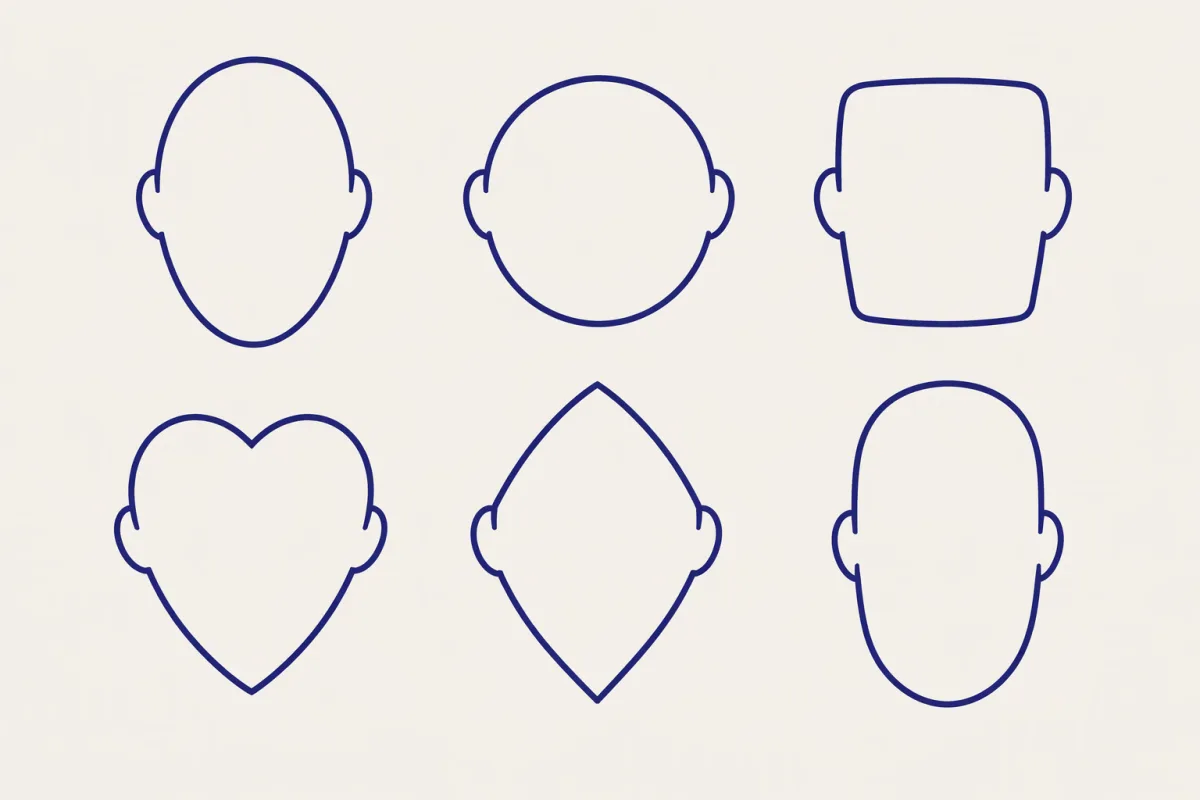
The six face shapes
Most people sit near a boundary between two shapes. These are the six the tool names, and the one measurement that separates each from its nearest neighbour.
Oval
Length about 1.4 times the width, jaw slightly narrower than the cheekbones, soft corners.
Nearest neighbour: oblong, which runs longer, from about 1.55.
Round
Length up to about 1.25 times the width, full cheeks, and a jaw corner with no hard edge.
Nearest neighbour: square, which shares the width but has a hard jaw.
Square
Length about 1.3 times the width, forehead, cheekbones and jaw nearly equal, with a sharp jaw corner.
Nearest neighbour: round, where the jaw angle decides it.
Heart
Widest at the forehead, tapering to a narrow, often pointed chin.
Nearest neighbour: diamond, where the cheekbones beat the forehead.
Diamond
Cheekbones clearly widest, with both forehead and jaw narrower.
Nearest neighbour: heart. Check forehead against cheekbone width.
Oblong
Length about 1.55 times the width or more with near-parallel sides from temple to jaw.
Nearest neighbour: oval, which tapers more at the jaw.
Haircuts, glasses and necklines by face shape
The rule behind most advice is contrast: pick shapes that balance your face rather than repeat it. Angular faces soften with curves, while round faces gain structure from straight lines and height.
| Shape | Hair | Glasses | Neckline |
|---|---|---|---|
| Oval | Most cuts; long layers, curtain bangs | Square, browline | Crew, boat |
| Round | Height at the crown, side part, long layers | Rectangular, angular | V, scoop |
| Square | Soft waves, side-swept fringe | Round, oval | Scoop, cowl |
| Heart | Chin-length volume, side part | Light rimless, bottom-heavy | Boat, scoop |
| Diamond | Fringe or width at forehead and jaw | Oval, cat-eye | Crew, collar |
| Oblong | Width at the sides, blunt fringe | Deep, oversized frames | Crew, turtleneck |
Questions
Is my photo uploaded?
Not by this tool. The landmark model and its files load from this site, then the measuring happens in your browser. The photo stays in the tab until you press clear or close the page. Other tools on the site may work differently and say so on their own pages.
Why is my result split between two shapes?
The measurements are continuous. A length ratio of 1.5 sits between oval and oblong, and forcing a single label would hide that. When the margin is small we show the runner-up so you can read both lists of advice.
Can I keep my glasses on?
The ratios come from the hairline, cheekbones, jaw and chin, so thin glasses rarely matter. Take them off if the frames cover your temples or cheeks.
Does a beard or bangs change the result?
A full beard widens the measured jaw and flattens its angle, which pushes results toward square or oblong. Bangs can hide the hairline, so pin hair back for the most reliable reading.
What if nothing is detected?
Usually the photo is at an angle, backlit, or taken so close to the lens that the jaw is distorted. Step back, face the light, and keep your whole face in frame.